
The mango seemed to have everything. Ripe and attractive beneath the supermarket lights, it looked as though it had been waiting for Sapito. One glance made the aisle disappear for a moment and brought back his aunt’s farm.
The memory held leafy trees, oranges and mangoes. It held the pleasure of climbing, reaching for fruit and eating it there. Nobody had to explain why it tasted good. The flavour and the place belonged together.
Sapito picked up several mangoes and some bananas. The price at the checkout returned him to the present. The original account remembers twenty-nine Australian dollars and fifty cents for three mangoes and five bananas. That is a recollection of one historical purchase, not a current price comparison.
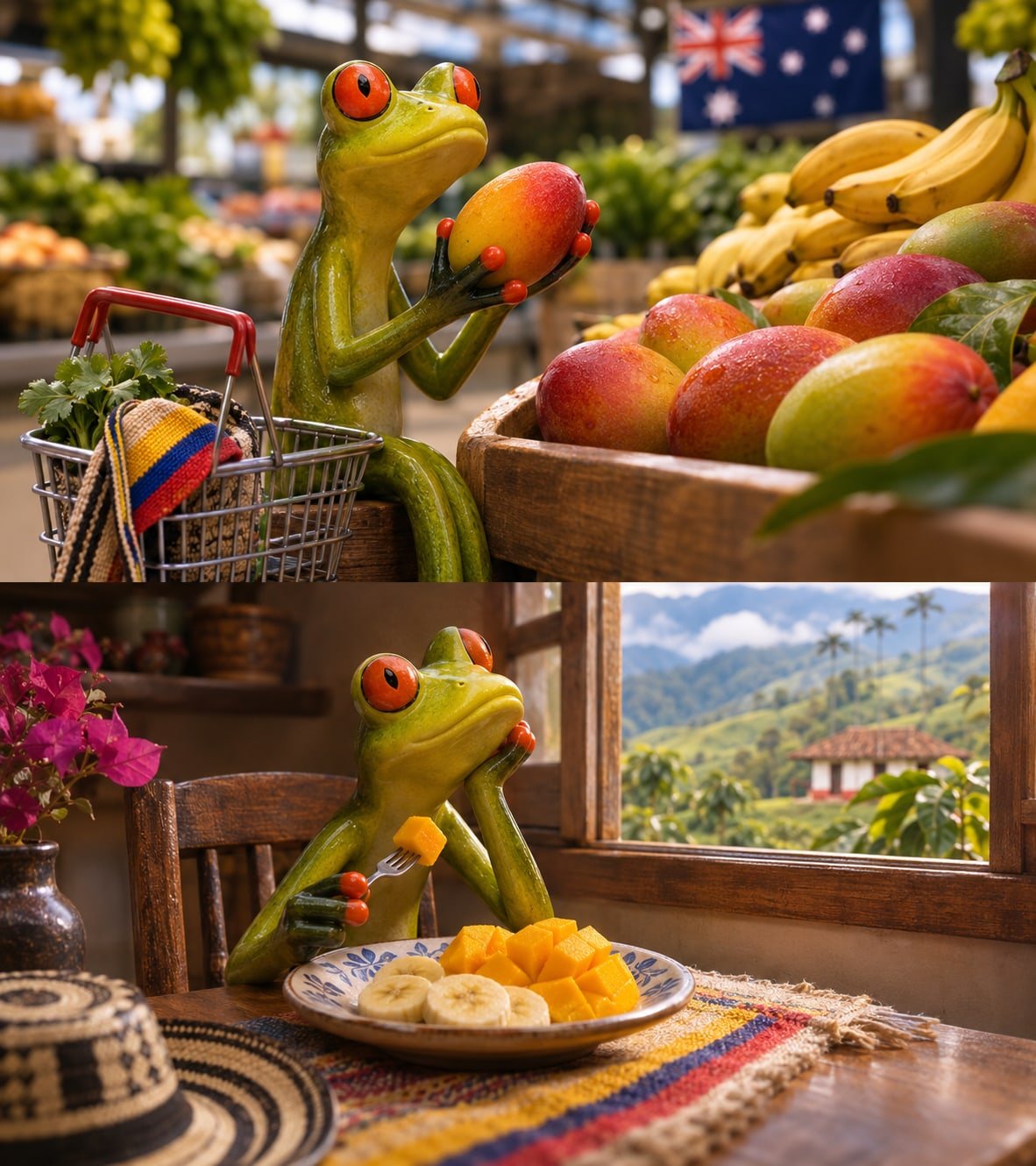
He knew wages, currencies and markets differed. Still, his mind converted the amount into pesos and calculated what it might have bought in Colombia. The small collection of fruit seemed expensive, but a promise had attached itself to the purchase: a few minutes with a familiar taste.
At home, he cut the mango and banana, sat down and took a bite. The promise did not come true.
He was not claiming the fruit was bad. The disappointment was harder to describe. There was fruit in front of him, but he had expected a memory. A supermarket mango was competing with one eaten in a tree, in another country, at another time of life. The comparison was uneven before it began.
He had similar experiences with meat, chicken and the ingredients for a Colombian stew. Trying to reproduce a familiar meal brought a different result. The potato did not give the texture he expected. The whole dish failed to match the picture in his memory.
These are Sapito’s impressions, not evidence that one country’s food is artificial or inferior. Even he could not separate how much the ingredients differed from how much his homesickness contributed.
Friends described similar experiences. Their conversation did not solve the recipe, but helped him understand the expectation. Sometimes what someone hopes to buy is not on the shelf.
Sapito had gone to the supermarket for fruit. Without noticing, he had tried to buy a piece of childhood.
Do we miss a flavour or the life we had when we first knew it?